
Overview
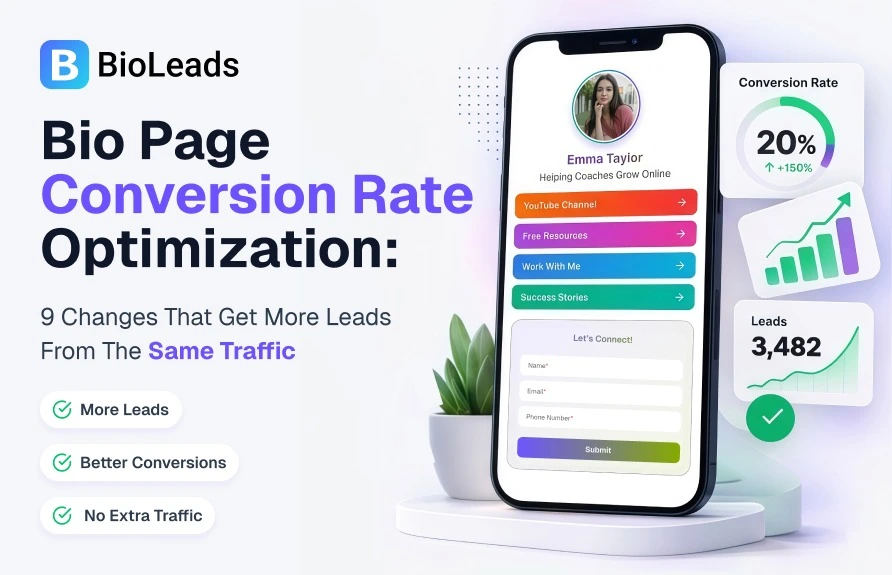
Conversion rate optimisation for bio pages is the practice of making specific, measurable changes to your bio page design, copy, and structure with the goal of converting a higher percentage of visitors into leads. If your bio page currently converts 8 percent of visitors into leads and you improve that to 20 percent, you have effectively more than doubled your lead volume without acquiring a single additional visitor.
This guide covers nine specific changes — each one actionable within a single editing session — that consistently improve bio page conversion rates across different niches and audience types.
1. Move the lead form above the fold
The most common reason for a low bio page conversion rate is simple: the form is not visible without scrolling. On mobile devices — where the majority of bio link traffic arrives — users scroll less than you expect. If the lead form is below your fourth or fifth link, a significant portion of your visitors will never see it.
Test placing the form immediately below your profile information, before any links. For pages where the lead capture is the primary goal, this placement consistently outperforms form-at-the-bottom layouts by a substantial margin.
2. Replace a vague offer with a specific one
The offer headline above your form is the single most impactful piece of copy on your bio page. A vague offer — "sign up for updates," "join my newsletter," "subscribe for more" — gives a visitor no specific reason to act. A specific offer describes exactly what the visitor gets and why it is valuable.
Compare these two headlines for a business coach:
- Weak: "Join my email list for business tips"
- Strong: "Get the exact 5-step client acquisition framework I used to land my first 10 consulting clients — free"
The specific version is longer but it converts at a higher rate because it answers the visitor's unspoken question: "What exactly am I getting and is it worth sharing my email address?"
3. Reduce the number of form fields
Every field you add to a form reduces the completion rate. The drop-off between a one-field form (email only) and a three-field form (name, email, phone) is significant — typically between 20 and 40 percent fewer completions. Only collect what you genuinely need at the first interaction. Name and email covers the majority of use cases. Phone number should only be requested when follow-up will actually occur by phone or SMS, and the visitor has been given a clear reason why it is needed.
4. Rewrite your submit button text
The text on your form submit button is a micro-decision point. "Submit" and "Subscribe" are the two weakest options because they describe an action the visitor takes rather than a benefit they receive. Rewrite the button text to describe the outcome:
- "Send me the free guide" outperforms "Submit"
- "Get instant access" outperforms "Sign up"
- "Start capturing leads" outperforms "Subscribe"
This is a five-second change that can meaningfully improve conversion rates on its own.
5. Trim your link list to five or fewer
More links create a paradox of choice. When a visitor sees twelve links on a bio page, the cognitive load of deciding which to click often results in clicking none. Cut your link list to the five most important destinations. If you cannot decide which five to keep, ask yourself: which links have produced leads or revenue in the past 90 days? Keep those. Archive the rest.
6. Add a social proof line near the form
A single line of social proof placed immediately above or below the form offer reduces the visitor's hesitation about submitting their contact details. Examples that work:
- "Joined by 1,400 creators already"
- "Downloaded by 800+ consultants this month"
- "Read by founders at Flipkart, Razorpay, and Zepto"
Use real numbers. If you do not yet have large numbers, use quality indicators instead: "Recommended by three YC founders" or "Featured in Entrepreneur India" if true. Do not fabricate social proof — visitors can tell.
7. Match your page headline to your profile bio
When a visitor clicks your bio link, they arrive with an expectation set by whatever your profile bio says. If your Instagram bio says "helping coaches build 6-figure practices" and your bio page headline says something completely different, the mismatch creates friction. Maintain continuity between your profile bio text and your bio page headline — the visitor should feel they have arrived in the right place, not been redirected somewhere unexpected.
8. Add a one-line privacy reassurance
One of the reasons visitors hesitate before submitting a form is concern about what will happen to their contact details. A single line of reassurance below the form address this directly. "No spam. Unsubscribe any time." or "Your details are only used to send you what you asked for" has a measurable positive effect on form completion rates, particularly for audiences that are not yet deeply familiar with your brand.
9. Test your page on mobile before publishing
Most bio link traffic arrives on mobile devices. If your page is not tested and optimised for mobile before going live, you are losing conversions from the majority of your audience. Check that the form is visible without scrolling, that button text is readable, that fields are large enough to tap easily, and that the page loads quickly on a mobile data connection. BioLeads pages are mobile-optimised by default, but always verify the experience yourself before sending your audience to a new page.
What to do next
- Check your current bio page conversion rate in BioLeads analytics.
- Identify which of the nine changes above has not yet been applied to your page.
- Make one change at a time and run it for at least one week before making another change — this gives you cleaner data on what is working.
- Set a target conversion rate of 20 percent and work toward it methodically.
Conversion optimisation is not a one-time task. It is an ongoing process of testing, measuring, and improving. Even small improvements compound significantly over time. Start optimising your bio page conversion rate free on BioLeads.

Company
Product Team at BioLeads
BioLeads is built and maintained by Approid Tech, a software product company helping creators, consultants, and small businesses turn social traffic into organised leads.
Share this article