
Overview
Consultants, coaches, and independent professionals face a common early-stage problem: they need clients before they have the infrastructure most people assume is required to get clients. A full website, a polished case study section, a booking system — these take weeks or months to build and often get in the way of simply starting.
A lead capture bio page solves this problem. It is a single page that does everything a consultant needs in the early stage of client acquisition: it establishes credibility, describes the service, and captures the contact details of interested prospects in one place. It lives at a simple URL you can share anywhere, and it can be live within an hour.
Why most consultants lose leads from social media
A consultant who builds a visible presence on LinkedIn, Twitter, or Instagram is generating attention from potential clients every day. People read a post, find it useful, click through to the profile, see the bio, and then — in most cases — do nothing. There is nowhere specific to go, no clear action to take, and no way for the consultant to follow up.
The bio link is usually either missing, pointing to a general website homepage, or linking to a Calendly booking page that feels premature for a cold visitor who is not yet sure they want a call.
A lead capture bio page fixes this by giving the visitor a more appropriate first step: sharing their contact details and a brief description of what they need, before any commitment to a call is required.
What to include on a consultant bio page
A clear statement of who you help and how
The headline of your bio page should answer one question in under ten words: what do you do and for whom? "I help B2B SaaS companies reduce churn" is more effective than "consultant and advisor." Specificity converts. Vagueness does not.
Three to five proof points
Below your headline, add short evidence of your results. These do not need to be formal case studies. A one-line outcome — "helped 12 startups raise seed rounds in 2024" or "reduced client onboarding time by 60% across four engagements" — is enough to establish credibility at the bio page stage.
A focused lead form
For consultants, the lead form should collect more context than a standard email opt-in. In addition to name and email, consider adding a single qualifying question: "What is your biggest challenge right now?" or "What type of support are you looking for?" This gives you enough information to personalise your follow-up and filter genuinely qualified leads from general interest.
Your key links
Include links to your LinkedIn profile, one or two pieces of representative work or writing, and your primary content channel if you have one. Do not link to a general website homepage — it diffuses attention. Each link should go to a specific, valuable destination.
The consultant lead pipeline workflow
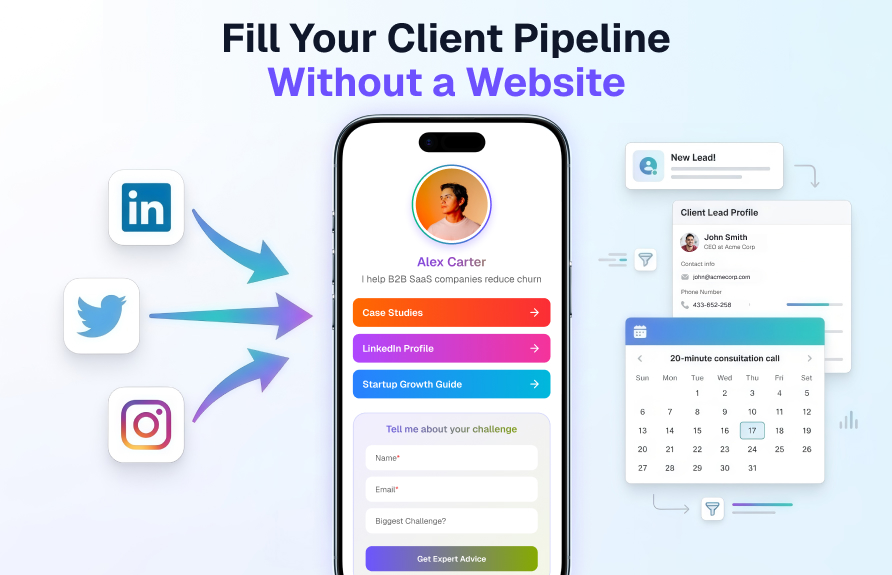
A BioLeads page integrates into a simple client acquisition workflow that does not require a CRM, a complex website, or an agency to manage it.
Stage 1 — Attention. A potential client finds your content on LinkedIn, Twitter, or Instagram. They read something useful or see evidence of your expertise.
Stage 2 — Profile visit. They visit your profile and click the bio link.
Stage 3 — Lead capture. They arrive at your BioLeads page, read your headline and proof points, and fill in the lead form with their name, email, and initial context about what they need.
Stage 4 — Notification and follow-up. BioLeads sends you an instant notification with the lead details. You follow up directly within 24 hours while interest is still high. The lead also receives your auto-responder email with a clear next step.
Stage 5 — Qualification call. Based on the form responses, you decide which leads to pursue. You book a call with qualified prospects. The bio page has already done the initial qualification work.
Writing an auto-responder that moves leads toward a call
The email that goes out automatically when someone submits your lead form is the most important email in your pipeline. It arrives when interest is at its peak. Write it with three goals in mind:
- Confirm and deliver. Acknowledge the submission and deliver whatever you promised in the form offer immediately.
- Establish credibility. Include one brief, specific proof point — a result you have achieved for a client, a credential, or a recognisable company you have worked with.
- Invite the next step. End with a single, low-friction call to action. A link to book a 20-minute call is appropriate here because the lead has already self-selected by filling in the form. Keep the booking link simple — Calendly or any basic scheduling tool works.
What to do next
- Create a BioLeads page with a specific headline describing who you help and how.
- Add three one-line proof points or outcomes from past work.
- Set up a lead form with name, email, and one qualifying question.
- Write your auto-responder email and connect your scheduling link.
- Update your LinkedIn, Twitter, and Instagram bio links to your new BioLeads URL.
- Post three pieces of content this week that end with a reference to the free resource or offer in your bio link.
You do not need a full website to start filling a client pipeline. You need one focused page that captures interest before it disappears. Build yours free on BioLeads.

Company
Product Team at BioLeads
BioLeads is built and maintained by Approid Tech, a software product company helping creators, consultants, and small businesses turn social traffic into organised leads.
Share this article